¶ First Look at the ESP32
¶ What Is the ESP32?
The ESP32 is a family of highly integrated Wi-Fi (802.11 b/g/n) and Bluetooth (Classic + BLE 4.2/5.x) System-on-Chip (SoC) solutions developed by Espressif Systems (Shanghai, China). Designed to meet the growing demand for high-performance, low-power, and cost-effective IoT applications, the ESP32 builds upon the success of its predecessor, the ESP8266, by offering significantly improved processing capability, lower power consumption, and expanded peripheral support.
-ESP32-based modules and development boards excel at reading a wide variety of inputs:
- Environmental data (via sensors connected to ADC or digital bus interfaces)
- Biometric and motion signals (via I²C/SPI sensors such as heart-rate or IMU modules)
- Audio and image data (via dedicated peripherals or expansion boards)
- Remote network commands (via Wi-Fi or BLE)
They can then generate comprehensive output responses, such as:
- Driving motors, servos, and actuators (using PWM or dedicated driver interfaces)
- Uploading data to cloud platforms (MQTT/HTTP with AWS IoT, Aliyun, Azure IoT Hub, etc.)
- Rendering information on displays (I²C OLED displays, SPI TFT screens)
- Performing audio playback and simple voice-based interaction (via integrated DAC)
Common development frameworks include Arduino Core for ESP32, MicroPython, and ESP-IDF (the official Espressif development framework). For beginners, the Arduino IDE with the ESP32 core provides the simplest entry point while retaining access to advanced ESP32 peripherals.
Thanks to a strong global developer community, the ESP32 ecosystem provides abundant open-source libraries, tutorials, and sample projects—such as ESPAsyncWebServer for network applications or Adafruit SSD1306 for OLED displays—making rapid prototyping easier than ever.
Whether you want to build:
- a portable weather station that syncs real-time data to your phone via Wi-Fi,
- a smart-home controller with BLE and voice commands,
- a battery-powered sensor node that runs for months,
- a Wi-Fi-controlled obstacle-avoidance robot,
- or a wearable device for health monitoring and BLE notifications
the ESP32 gives you all the hardware foundations to turn ideas into working prototypes.
¶ ESP32 Development Board Overview
This section uses the ESP32 DevKit V1 as an example to explain the core components and essential pin functions.
¶ (1) Main Components
- ESP32 Module – dual-core 32-bit processor with Wi-Fi and Bluetooth capability.
- Power regulation circuitry – converts USB or Vin supply to stable 3.3V.
- USB-to-UART bridge – provides programming and serial communication via USB.
- Crystal oscillator – provides the clock source for stable ESP32 operation.
¶ (2) Power Specifications
The ESP32 DevKit V1 supports two primary power-input methods:
USB Type-C / Micro-USB: Ideal for development; supplies 5V input and enables code uploading.
Vin pin (5–12V): Accepts external DC input; the onboard LDO regulator converts it to 3.3V for the ESP32.
Important Notes:
- Do NOT exceed 12V on Vin, or the regulator and ESP32 module may be damaged.
- All ESP32 GPIO pins operate at 3.3V logic.
- Do not directly connect 5V signals—use a level shifter when necessary.
¶ 4. Important Pin Functions
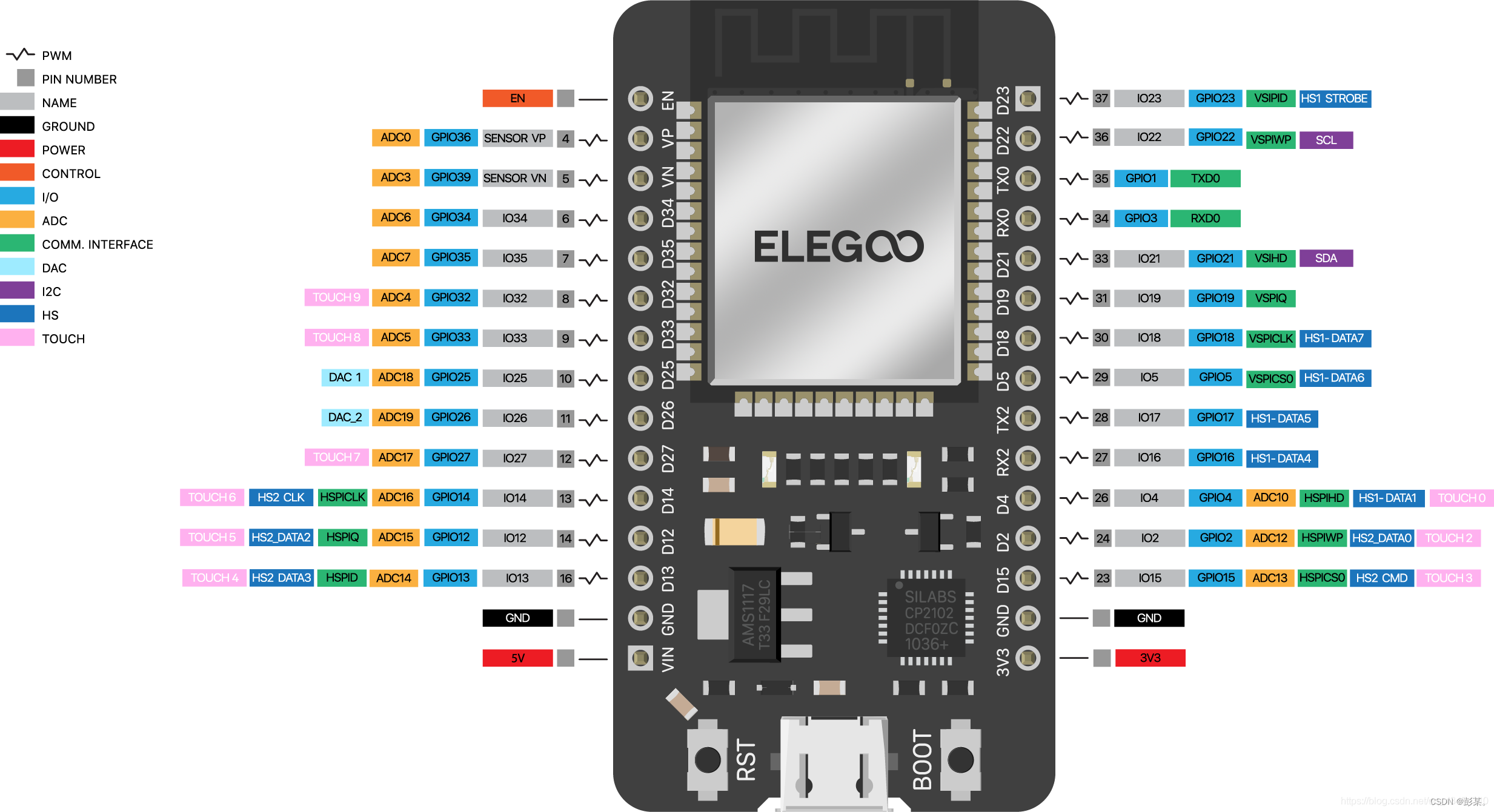
ESP32 pins are configurable through software (multiplexed peripherals). Below is an organized summary:
¶ (1) Power & Ground Pins
3V3 – 3.3V regulated output : useful for powering low-current sensors and modules (up to ~500mA).
GND – multiple ground points: all external modules must share GND.
Vin: external 5–12V power input.
¶ (2) General-Purpose GPIO Pins
Examples:
- GPIO15 (D15) – supports PWM, SPI functions.
- GPIO2 (D2) – ADC-capable; must remain high at boot to avoid startup issues.
- GPIO4 (D4) – GPIO with touch and ADC support.
- GPIO5 (D5) – often used as VSPI clock.
- GPIO13/12/14 – versatile GPIOs supporting PWM, SPI, and touch (but note GPIO12 affects boot voltage settings).
¶ (3) UART Pins
- GPIO16 (RX2) / GPIO17 (TX2) – UART2 communication or general I/O.
- GPIO3 (RX0) / GPIO1 (TX0) – UART0 (USB serial) used for programming and debugging.
¶ (4) ADC / DAC / Touch Pins
- GPIO27 / GPIO32 / GPIO33 – ADC inputs, some with touch sensing.
- GPIO34 / GPIO35 / GPIO36 / GPIO39 (VP/VN) – ADC-only, input-only pins.
- GPIO25 / GPIO26 – support both ADC input and DAC output.
¶ (5) Bus Interface Pins
- I²C – GPIO21 (SDA), GPIO22 (SCL)
- SPI (VSPI) –
- GPIO18 – SCK
- GPIO19 – MIS
- GPIO23 – MOSI
- GPIO5 – CS
- EN pin – chip-enable; active-high.
¶ 5. 3D Model Download
You can directly download the compressed package provided on this page. Once extracted, you will obtain the .step file for the motherboard, which can serve as a reference for 3D modeling.
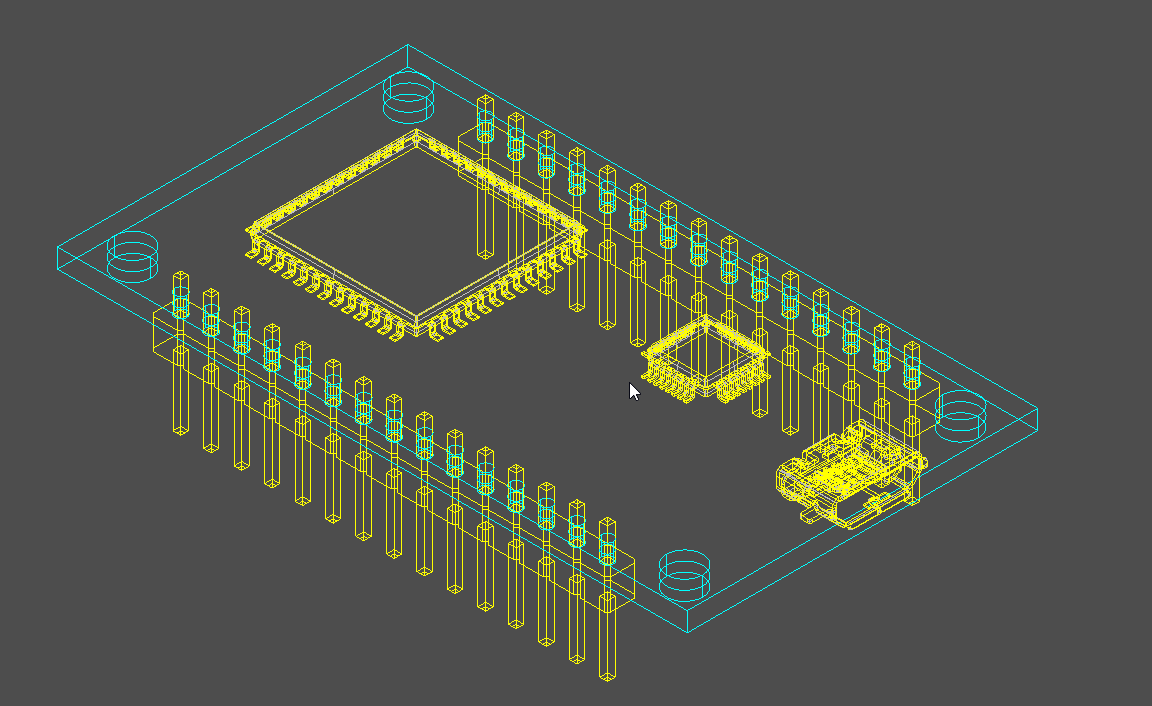
https://sketchfab.com/3d-models/esp32-78c2b5a932a1463bbc6e8ada630a0545
¶ 6. Advantages of the ESP32 DevKit
Extensive hardware expandability – multiple GPIOs and peripheral interfaces suitable for diverse applications.
Rich software ecosystem – supports Arduino, MicroPython, and ESP-IDF; large library availability improves development efficiency.
Strong community & documentation – numerous open-source examples and tutorials accelerate learning and project development.
Further Reading:
For more information, refer to Espressif's official documentation:
https://docs.espressif.com/projects/esp-dev-kits/en/latest/esp32/