¶ First Look at the ELEGOO MEGA2560 R3
¶ What Is the ELEGOO MEGA2560 R3?
The ELEGOO MEGA2560 R3 is an open-source microcontroller board based on the ATmega2560-16AU chip from Microchip Technology. Designed for complex projects that require more I/O pins, memory, and serial communication than a standard Arduino Uno, the MEGA2560 R3 builds upon the Arduino ecosystem while offering expanded capabilities for robotics, 3D printing, and industrial automation applications.
MEGA2560-based boards excel at handling a wide variety of inputs:
- Digital signals from switches, buttons, and sensors
- Analog data from potentiometers, temperature sensors, and light detectors
- Serial communication from GPS modules, Bluetooth adapters, and RFID readers
- Multiple simultaneous data streams from complex sensor arrays
They can generate comprehensive output responses, such as:
- Driving motors, servos, and stepper motors (using PWM or dedicated driver interfaces)
- Controlling relays, LEDs, and digital displays
- Communicating with other devices via UART, I2C, and SPI protocols
- Logging data to SD cards or transmitting to serial terminals
Common development frameworks include the Arduino IDE (with built-in Mega2560 support) and PlatformIO. For beginners, the Arduino IDE provides the simplest entry point with access to thousands of libraries and tutorials.
Thanks to a strong global maker community, the MEGA2560 ecosystem provides abundant open-source libraries and sample projects—such as Servo for motor control or LiquidCrystal for display interfaces—making rapid prototyping easier than ever.
Whether you want to build:
- a robotics platform with multiple servos and sensors,
- a 3D printer controller with precise stepper motor control,
- a data logging system with multiple analog inputs,
- an industrial automation system with relay control,
- or a multi-sensor monitoring station with serial output
the MEGA2560 R3 gives you all the hardware foundations to turn ideas into working prototypes.
¶ MEGA2560 R3 Development Board Overview
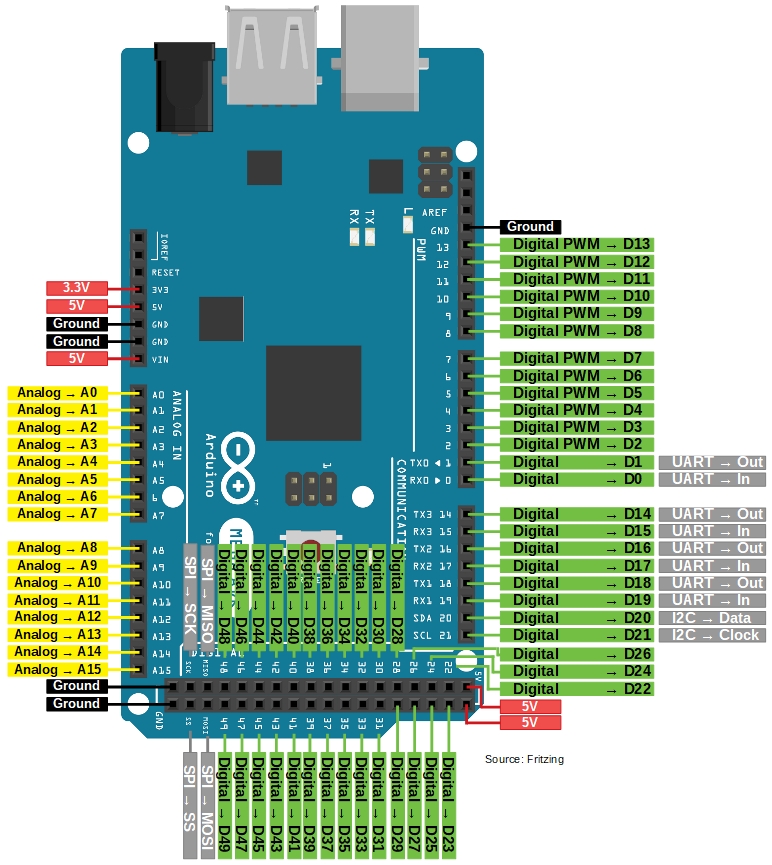
This section uses the ELEGOO MEGA2560 R3 as an example to explain the core components and essential pin functions.
¶ (1) Main Components
- ATmega2560-16AU Microcontroller – 8-bit AVR processor with 256KB flash and 8KB SRAM.
- Power Regulation Circuitry – converts USB or Vin supply to stable 5V and 3.3V.
- USB-to-UART Bridge (ATmega16U2) – provides programming and serial communication via USB.
- Crystal Oscillator (16 MHz) – provides the clock source for stable operation.
- Reset Circuitry – enables hardware reset and bootloader activation.
¶ (2) Power Specifications
The ELEGOO MEGA2560 R3 supports three primary power-input methods:
USB Type-B: Ideal for development; supplies 5V input and enables code uploading.
Vin pin (7–12V): Accepts external DC input; the onboard regulator converts it to 5V for the microcontroller.
DC Power Jack: Accepts 7–12V external power supply.
Important Notes:
- Do NOT exceed 12V on Vin, or the regulator and microcontroller may be damaged.
- All MEGA2560 GPIO pins operate at 5V logic.
- 3.3V output is limited to ~50mA – use external regulators for high-current devices.
¶ Important Pin Functions
MEGA2560 pins have fixed functions (not software-configurable like ESP32). Below is an organized summary:
¶ (1) Power & Ground Pins
5V – 5V regulated output: useful for powering sensors and modules (up to ~800mA).
3.3V – 3.3V regulated output: for low-voltage components (up to ~50mA).
GND – multiple ground points: all external modules must share GND.
Vin: external 7–12V power input.
¶ (2) General-Purpose Digital I/O Pins (0–53)
Examples:
- Pin 13 (L LED) – built-in LED; commonly used for status indication.
- PWM Pins (2, 3, 5, 6, 9, 10, 11, 44, 45, 46) – support pulse-width modulation.
- Interrupt Pins (2, 3) – external interrupt capability (INT0, INT1).
¶ (3) Analog Input Pins (A0–A15)
- 16-channel ADC – 10-bit resolution (0–1023), ideal for sensor reading.
- A0–A5 – also usable as digital pins (D54–D59).
¶ (4) UART Pins
- Serial0 (RX0/TX0 – Pins 0/1) – primary USB serial port for programming and debugging.
- Serial1 (RX1/TX1 – Pins 19/18) – secondary hardware serial.
- Serial2 (RX2/TX2 – Pins 17/16) – tertiary hardware serial.
- Serial3 (RX3/TX3 – Pins 15/14) – quaternary hardware serial.
¶ (5) Bus Interface Pins
- I²C – A4 (SDA), A5 (SCL) – two-wire interface for sensors and displays.
- SPI – Pin 13 (SCK), Pin 12 (MISO), Pin 11 (MOSI), Pin 10 (SS) – serial peripheral interface.
¶ (6) Special Pins
- Reset Button – resets the microcontroller and restarts the running sketch.
- ICSP Header – In-Circuit Serial Programming for direct chip programming.
¶ 3D Model Download
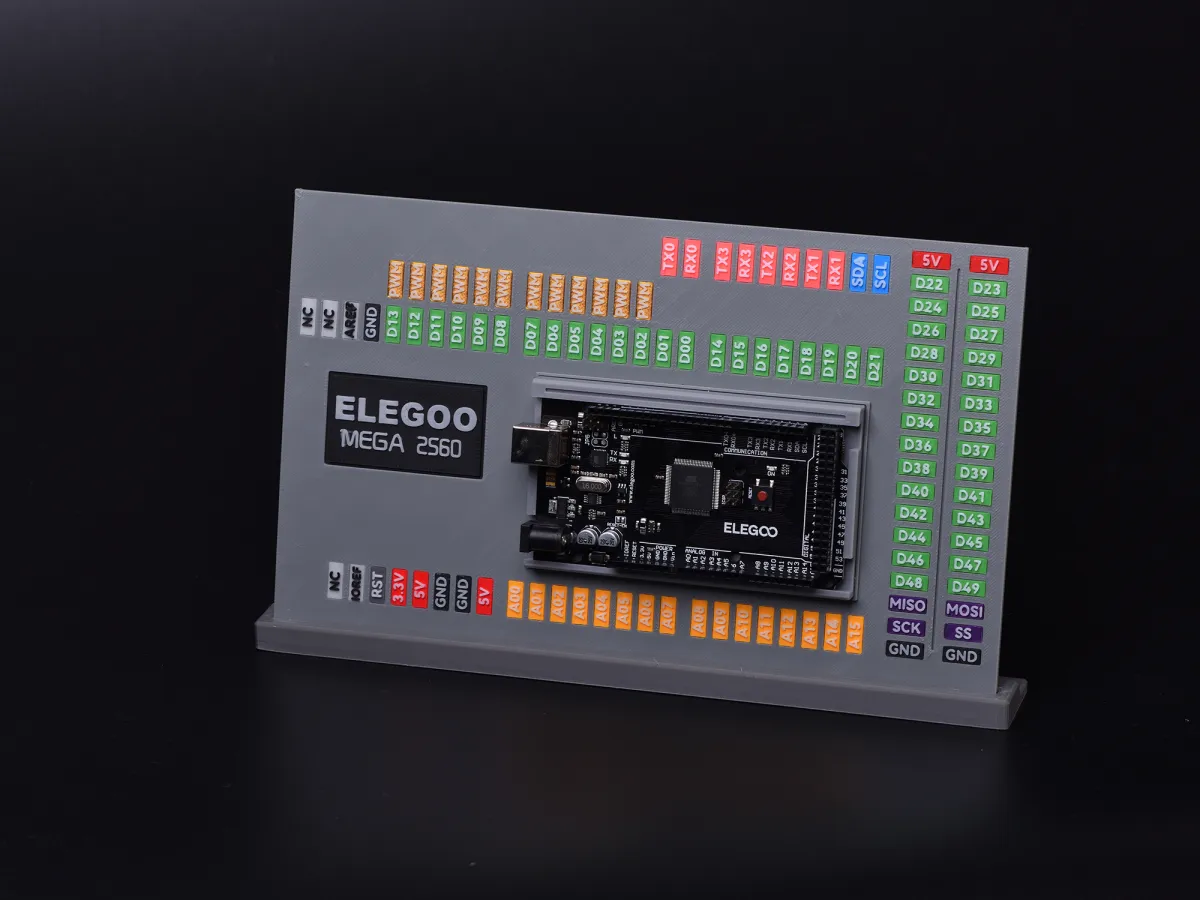
Alternatively, you may click the links provided on the page to download files in MF or other formats.
https://www.nexprint.com/zh/models/G6037665?printConfigId=G7764648
¶ Advantages of the ELEGOO MEGA2560 R3
- Extensive hardware expandability – 54 digital I/O pins, 16 analog inputs, and 4 hardware serial ports suitable for complex multi-sensor applications.
- Rich software ecosystem – fully compatible with Arduino IDE; thousands of open-source libraries available for rapid development.
- Strong community & documentation – abundant tutorials, projects, and maker resources accelerate learning and prototyping.
- Shield compatibility – works with most Arduino Uno/Mega shields, expanding functionality without additional wiring.
Further Reading:
For more information, refer to Arduino's official documentation:
https://docs.arduino.cc/hardware/mega-2560/